
Catalysis to Deliver Polymers from Carbon Dioxide and Greener Feedstocks
Carbon Dioxide and Epoxide Ring Opening Copolymerization
Carbon dioxide is well-known to be hard to activate and its chemistry is constrained by high thermodynamic stability and slow kinetics. Whilst small-scale, stoichiometric transformations are possible, truly catalytic processes feasible for use at scale are very rare. One such reaction is carbon dioxide and epoxide copolymerisation to form polycarbonates. This process forms lower embedded carbon products which have valuable properties and are needed at large-scale. Both the process viability and the range of polymer applications depend upon the selection of the polymerisation catalyst. Our team investigate innovative homogeneous catalysts, the best of which combine high activity, selectivity and operability under low CO2 pressures, including at 1 bar.
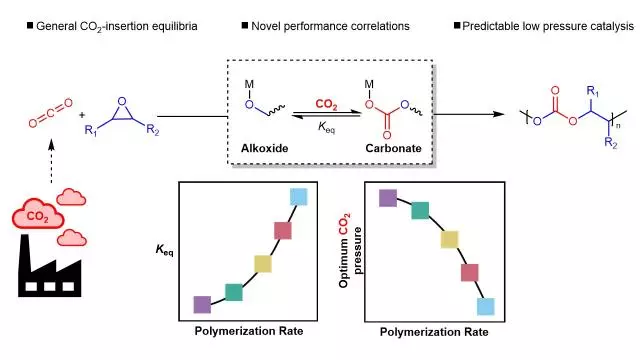
Ring Opening Copolymerisation (ROCOP) of CO2 and epoxides.
Our catalysts are formed using earth-abundant metals and exploit intermetallic synergy to deliver high performances and high carbon dioxide uptake into the polymer backbone. Understanding how to select the right metals for use in the catalysts is an on-going activity, many of our most successful catalysts combine s-block metals with first-row transition metals. Our research has shown that intermetallic synergy arises when each metal plays a distinctive and specific role in the catalytic cycle. Our team build specialist equipment, including for monitoring the catalysis during the reaction, to quantify the polymerization kinetics and develop the polymerization rate laws. We use the data from different series of catalysts to develop quantitative structure-performance models, with recent success in identifying catalytic linear free energy relationships. These are important because they allow for rational improvement of catalysis in future.
We discovered several high-activity catalysts which operate at low carbon dioxide pressures, including at 1 bar pressure. Understanding how carbon dioxide pressure influences catalysis is important and we have developed new models and kinetic methods to inform upon low-pressure catalysis. We discovered a generally applicable correlation between carbon dioxide insertion chemistry, in the key catalytic intermediates, and the polymerization ratees. Our theories successfully predict the minimum carbon dioxide pressure needed to achieve maximum polymerization rates: an important parameter for any larger-scale manufacturing so as to improve safety and reduce process energy costs.
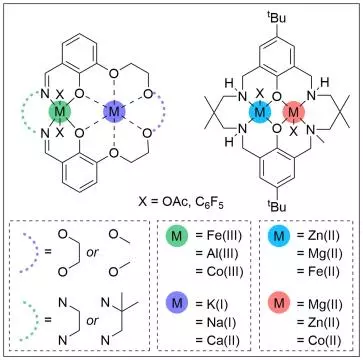
Synergic Bimetallic Polymerization Catalysts Featuring Earth-Abundant Metals
Catalysts to Make Polyesters and Carbonates
We also conduct research into polymerization catalysts for lactone or cyclic carbonate ring-opening polymerization (ROP) and epoxide/cyclic anhydride ring-opening copolymerization (ROCOP). Our catalysts show good control as well as high rates. This is important since it enables the production of more sophisticated polymers, including block polymers. Our research in polymerization catalysis focusses on using earth abundant metals, including synergic bimetallic catalysts and on identifying the polymerization rate laws. These kinetic data are used to underpin structure-performance relationships, with linear free energy relationships being essential to identify the right catalyst targets for future research.
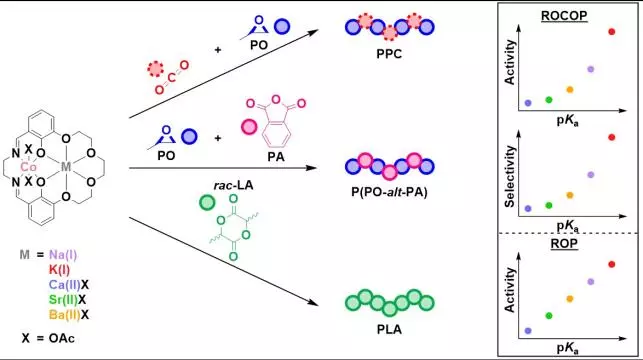
Polymerization Catalysis to Make Polyesters and Polycarbonates, with quantified structure-performance relationships.
Key Papers: