
Sustainable Materials and Applications
Our team investigate oxygenated polymers, many prepared using our innovative catalysis, for use as engineering plastics, elastomers, adhesives, surfactants and as ionically conductive electrolytes. We investigate polymer processing, properties and applications. Throughout the work, we aim to identify polymer structure-activity relationships so as to understand how to design materials for high-performances across the length scales. All our materials are designed to be fully reprocessable and recyclable to monomer, using low-energy processes. In some applications, the polymers must also be fully degradable and in those areas, we design for complete degradation to non-toxic metabolites.
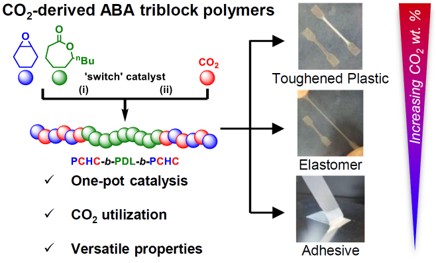
Switchable Catalysis Tailored to Produce Recyclable Plastics, Elastics and Adhesives.
We investigate block polymers and ionomers, exploiting a range of dynamic and non-covalent chemistries to deliver high-performance materials without any compromise to repair and degradability. We investigate materials properties using a range of rheology, thermal measurements and mechanical investigations. Our goal is to improve the properties of the leading bio-based and CO2-derived polymers so that they can fully replace todays hydrocarbon-based materials. Recent work has applied machine learning algorithms to better predict polymer properties from structures and the reverse to identify the right polymers to make for a target threshold of thermal and mechanical properties.
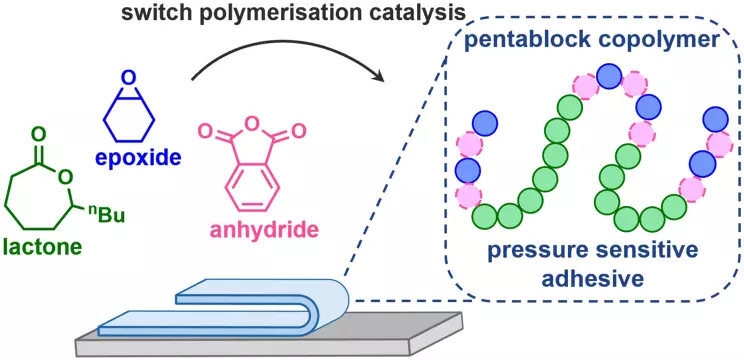
Polyester Pressure Sensitive Adhesives
Water Soluble and Degradable Polymers
Polymers are important in many water based formulated products including medicines, agriculture, paints, beauty products and more. Currently most of these water soluble polymers are not biodegradable which can create problems for both human and environmental toxicity after use. We investigate the production of renewably sourced water soluble polymers for use as surfactants. Our innovative catalysis provides access to a wide range of new chemistries and enables insight into structure-performance and structure-biodegradability relationships. Recent work has focussed on making amphiphiles from glycercol-derived monomers and carbon dioxide which show high water solubility, good properties as surfactants and which are stable in neutral or acidic solutions. These materials undergo fast and complete degradation under slightly basic conditions re-forming natural molecules and metabolites.
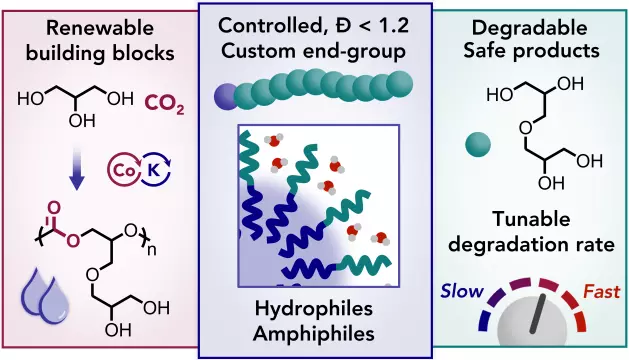
Fully degradable hydrophilic and amphiphilic polycarbonates.
Polyelectrolyte Binders for Batteries
Batteries are essential technologies for transportation, electronics and many more. Working with researchers in Oxford Materials, we have developed polymer electrolytes and conductive binders for use in high-performance batteries. The polymer binders are used in the cathode, delivering both processability and conductivity and helping materials respond to volume changes upon charge-discharge cycles. Cells featuring these polymers, including with NMC and LFP cathodes, show high capacity and stability (capacity retention) over charge-discharge cycles. They show equivalent performance to the fluoro-polymers (PFAs) which are currently used to make batteries and thus present an opportunity to design-away from persistent fluoro-chemicals. Some of the binders can be cleanly recycled back to monomers, helping with future battery recycling efforts.
Key Papers