
Recycling and Degradation
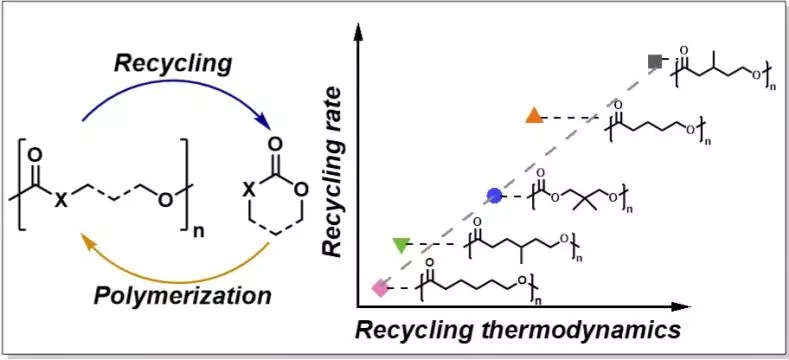
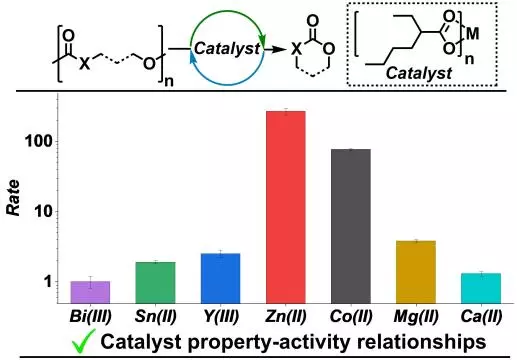
We design all our new polymers so that they can undergo low-energy re-processing. We also investigate the catalysed chemical recycling to monomer or depolymerization catalysis. These recycling reactions re-form the original monomers, often heterocycles, with catalysts enabling very efficient processes to occur with minimal energy input. We are interested to understand the correlation between polymer-monomer equilibria (thermodynamics) and the rates of these catalysed reactions. We have developed automated and miniaturized experiments to enable accurate recycling rate measurements and by investigating a range of different polyesters and polycarbonates have uncovered structure-activity relationships. These linear free energy relationships for recycling science correlate the polymer-monomer equilibria against rates of recycling. They are useful to select the lowest temperature conditions for effective and selective recycling and for separating mixtures of similar monomers by sequential depolymerization processes. The recycled monomers can be efficiently re-polymerized to produce polymers with high-value properties, this is important because mechanical recycling often compromises properties. We are also investigating how to select the best recycling catalyst for a target polymer waste, once again using detailed kinetic investigations to identify quantified linear free energy relationships.
Some polymers become environmentally dispersed during use, e.g. those in water based formulations or agricultural films. These materials need to be designed to be biodegradable. We investigate how the polymer structures, for oxygenated polymers, influence degradation chemistry. Through collaboration we assess biodegradability, following international standards. We design these polymers so that the rate of degradation can be predicted and controlled. We consider the by-products of degradation so as to minimise toxicity and ensure complete biodegradation.
Key Papers